


Muli mutya?
Having interviewed countless creatives over the years, I have come to realise that there are two interview sweet spots. The first is speaking to someone early in their career. There is often a candour and enthusiasm that gets sanded down over the years, and there is a joy in catching someone at the start, before that happens. The other sweet spot is at the opposite end of the spectrum, when creatives are so established that they can be reflective and honest about their careers.
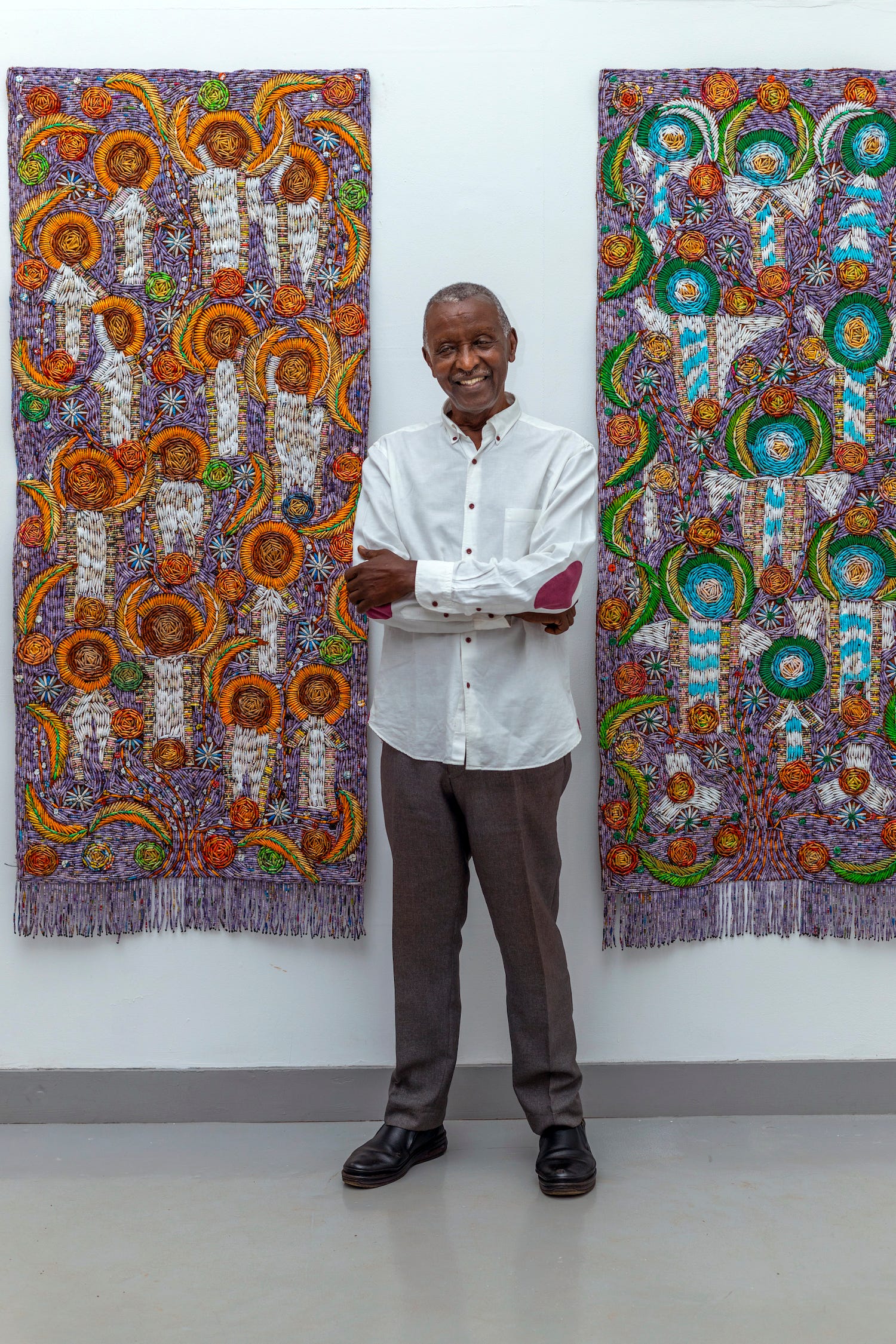
This week’s Creative You Should Know, the Ugandan artist Sanaa Gateja, is firmly in the second camp. Those familiar with his work will know him not only as one of the most important artists working in East Africa today, with works held in museums and private collections worldwide, but also as a renowned cultural activist. He is credited with helping to develop Uganda’s handicraft economy by teaching paper bead making to women and young people in communities across the country.
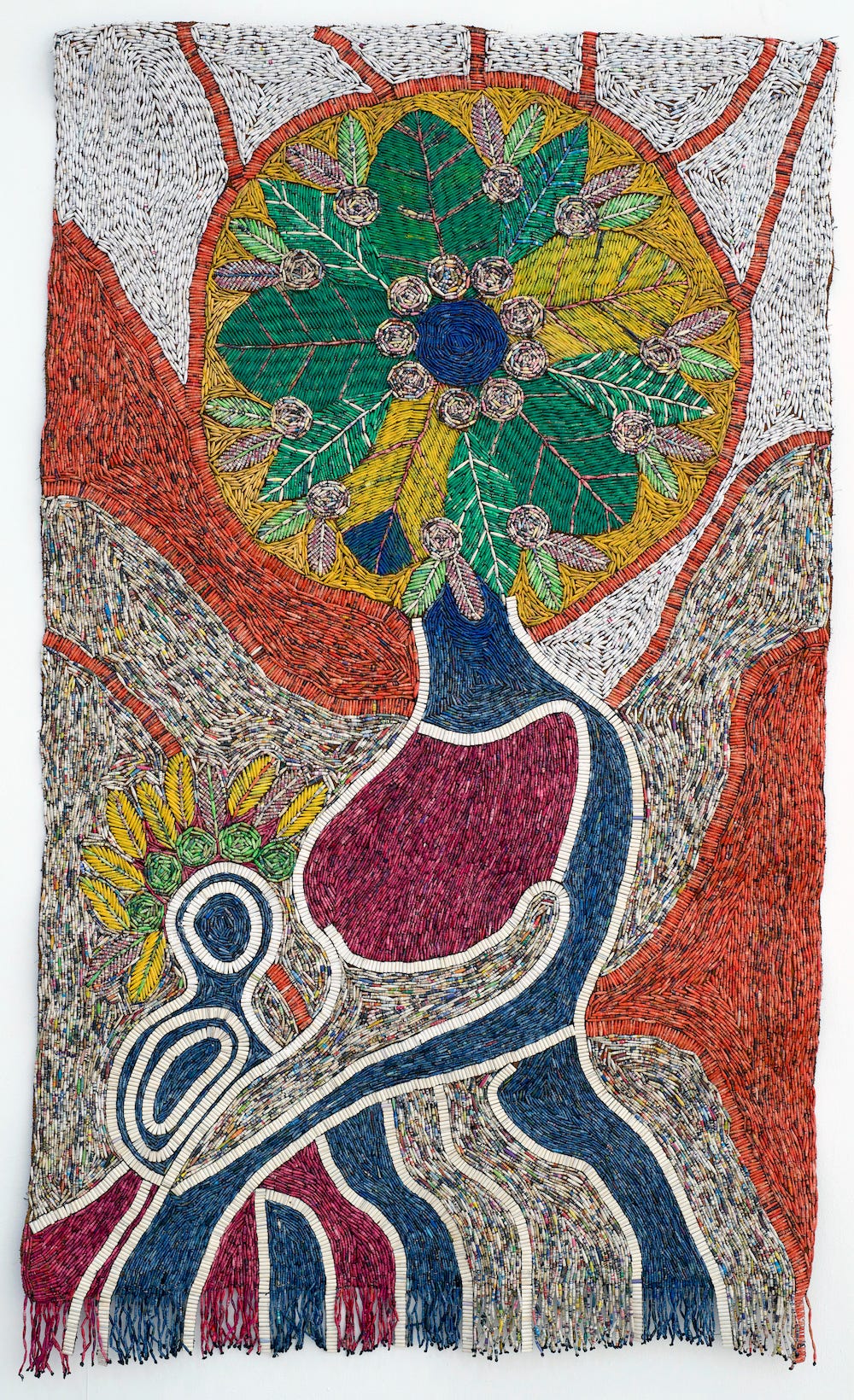
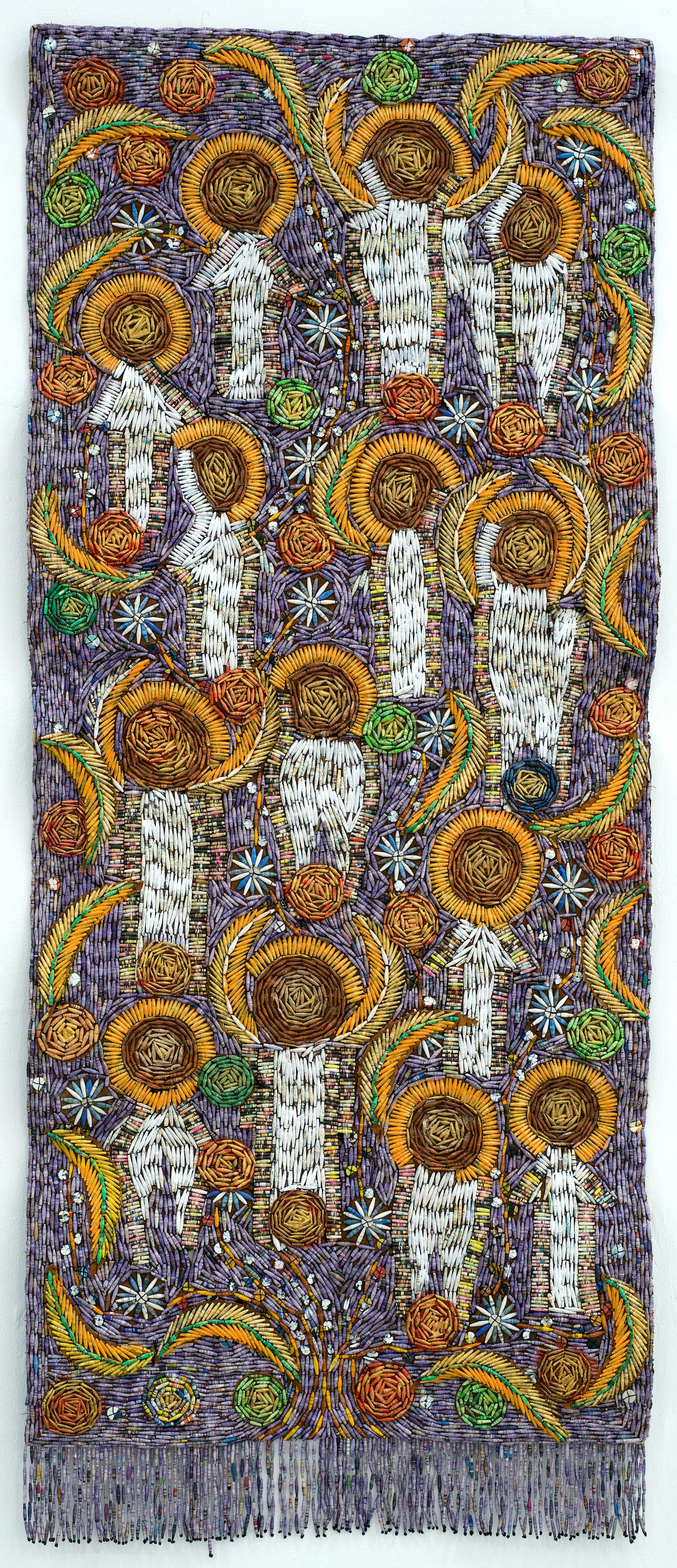
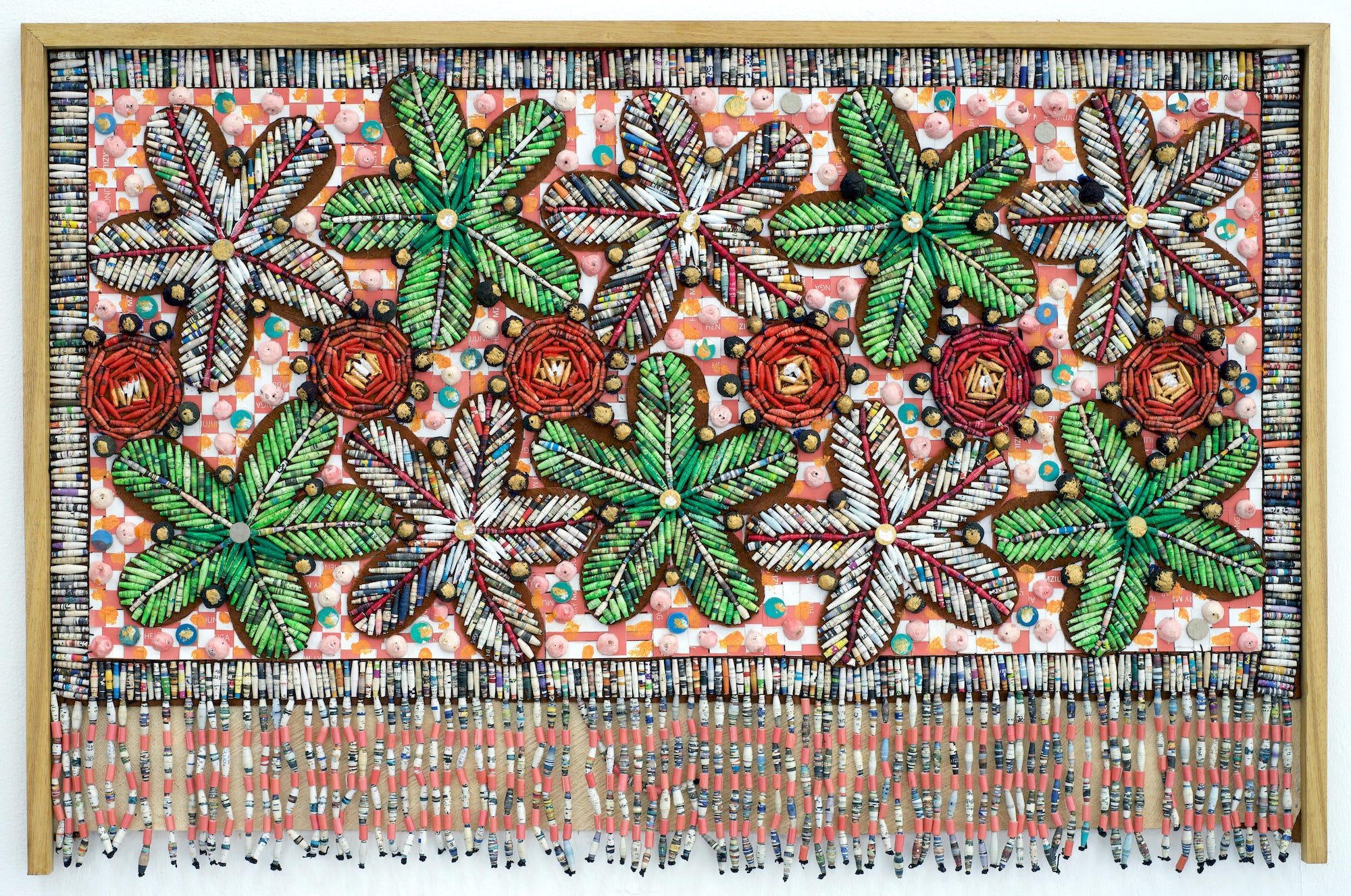
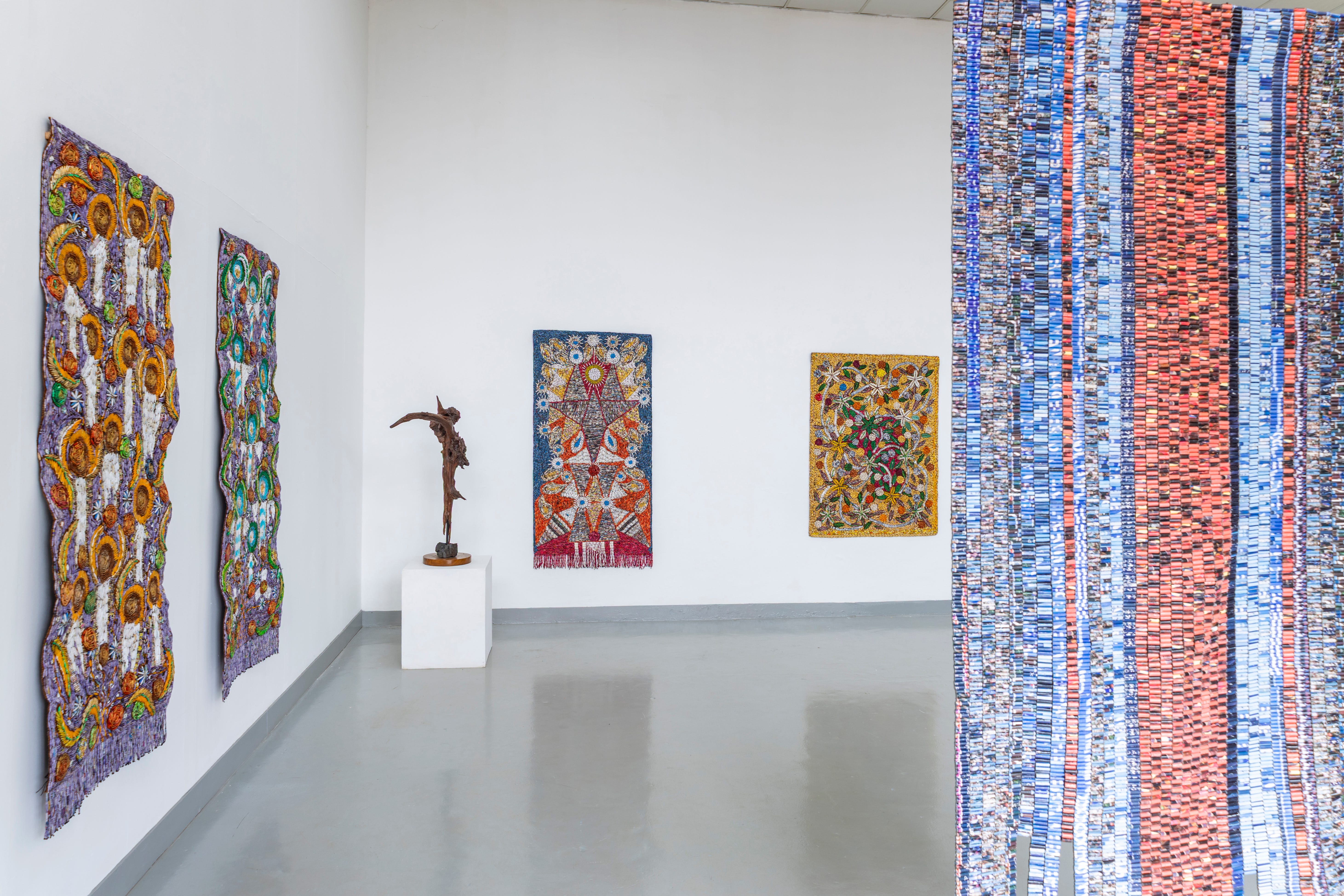
**His latest exhibition, They Too Are the Earth, is showing at Afriart Gallery in Kampala until 21 November.
How do you introduce yourself when people ask you who you are?
I’m a community artist. I recycle materials, especially paper, to make paper beads. I tend to work with materials near me. In the village, for example, we have banana fibre, raffia, and seeds. And as one walks around the farms or the forest, you pick up driftwood that has been left: the remains of fire, burning of forests or whatever it is. Sometimes ants have eaten the wood, and you find very interesting pieces. I pick up all these things. And so I could say I’m an environmental artist. I think this is the first time I have called myself an environmental artist.
You grew up around potters and blacksmiths and basket weavers in Kisoro. What did you learn from watching them that you still incorporate in your work today?
Well, it was a very interesting period, especially now, when you’re a much older person and you remember your childhood more clearly, and the kind of things we used to do, with no idea of wanting to learn, but wanting to experience.
You go to a blacksmith to make a knife for your home. My mother would say, “Take this and have a new knife made,” because we lived in a very rural kind of area where there were no shops at all. We did everything for ourselves. Pottery was made by a person in the village, and they would fire the pots, and we would play with their children, and we would create little animals ourselves, and then we put them in the fire and wait with anticipation at the end to reveal these beautiful little pieces of things. And the same with the blacksmith, who put you on the seat away from the fire and asked you to hold the bellows, and so you’d help with the bellows while looking at what they were doing. I think that’s how I became a jeweller later on, because I found that fire has that amazing ability to transform very hard material.
What role did art play in your life then?
In the community we lived in, there were dancers, mat makers, and carvers, and they did things on demand. As I told you, there were no shops. So the demand came from communal activities: a wedding, a harvest, or just somebody wanting a good, elaborate pipe made. So you found these things, which, as a child, I had no idea were art as such.
Later, in school, when I started studying art, I realised this was actually art. But our syllabuses were not teaching art; they were teaching sort of European art history. And then from the art history, you would practise what the famous artist did. You’d have your palettes and your canvas or your paper, and pen and sheets, and you’d do things like that. And I found it very challenging, because we didn’t have money to buy the materials. The schools could provide some, but on my own, which was always a very interesting time to experiment, I didn’t have that chance. So maybe I wasn’t that interested in it so much. I was so much interested in the other one, when I gradually realised that what we went through as children was actually art.
I understand that you joined the Ministry of Culture quite young, as a teenager, and you were running Uganda’s pavilion at Expo ‘70 in Osaka, Japan, at around the age of 20, which is very early. How did that come about?
I realise now that when one is humble to their workmates but interested in performing, results come in mysterious ways. I rose in status from cutting boxes and packing goods for the ministry to becoming a helper with purchases in the countryside. This was post-independence, when African countries were trying to create their identity away from the colonial identity, and so they looked at arts and crafts and community activities as a way of changing mindsets.
The ministry had a beautiful shop on the main street, and that’s where I got a job, after my secondary school. And I was really willing to work, because I could also see that through that performance I would get a chance to meet makers, see what they do. I would relive my childhood. And so that’s how my development became interesting to my bosses.
You mentioned that the art you saw in the school curriculum was very Eurocentric, and required materials that were expensive and not easily available. Was there a particular incident or artist that opened your eyes to African art, broadly speaking?
Yes. While working with the ministry, I met makers. And what fascinated me was that in particular regions they would be dealing with different materials, and they would be dealing with those materials differently from other areas. For example: one day when we were buying, I found a Land Rover door that had been made into a shield by the Karamojong people. It was an amazing creation, because it was beautifully made. It was a traditional shield made of metal, and it had the number plate of the car. So I realised many, many people do recycle things, because they don’t go to shops. There are no shops. Once you come from the city to the village with your plastic bags or with the metal pieces, people will turn around and create something out of them. So it was out of a need for materiality that I realised materials have a value: a specific value, to a particular need.
I’ve seen you referred to as the Bead King. How do you feel about that title?
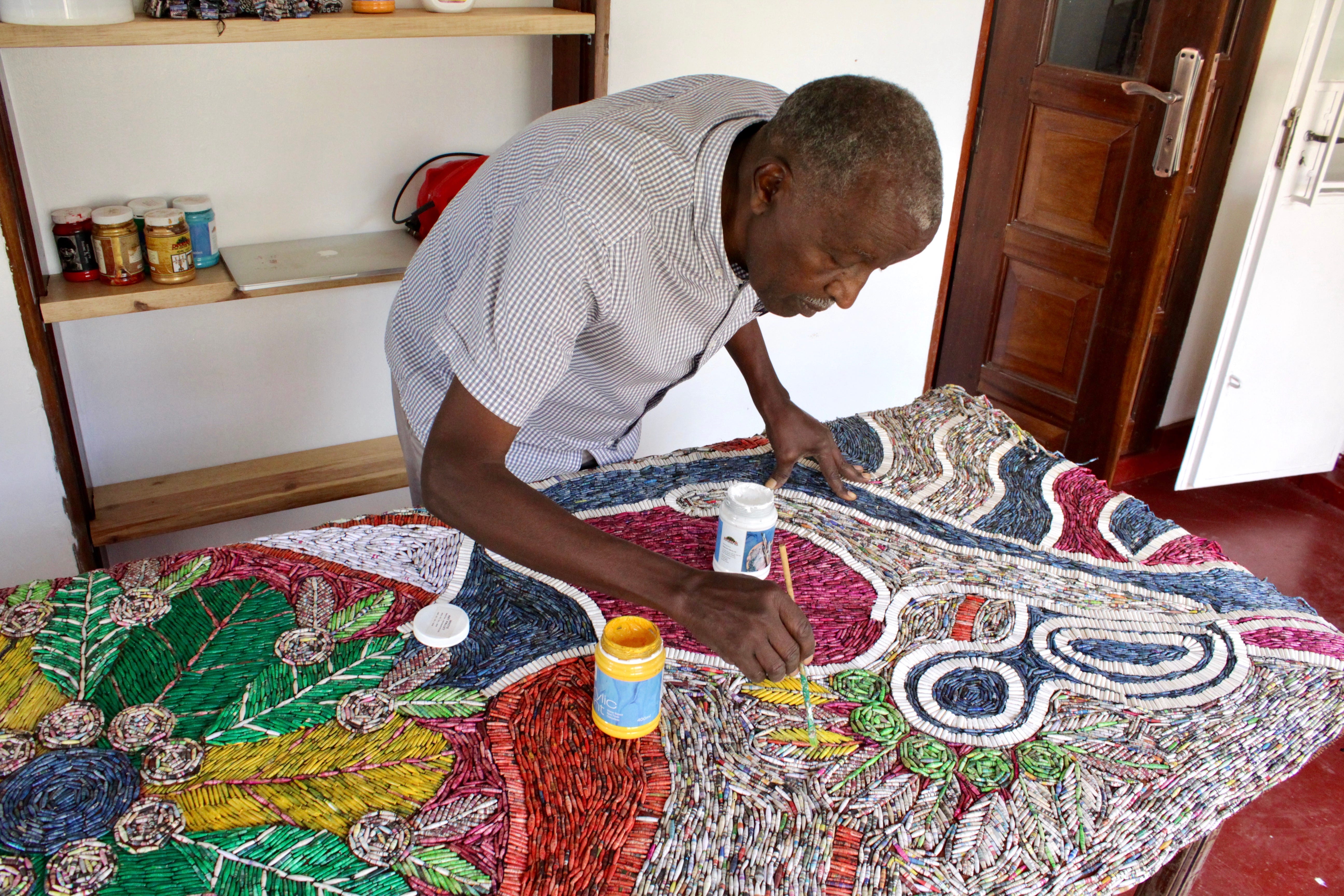
Somebody gave that to me. I find it presumptuous, but I don’t mind it, because in a way I started these beads here in East Africa, really, in the early‘90s. And they gradually moved from being made into products like necklaces and bags and table mats and hats. Now they’re actually artworks.
I’ve trained a lot of people in the beads. And I don’t find it strange or bad to train people to do exactly what I do, except the artwork, because art is something very personal. And so it’s up to them to do what they want to do with the beads. But many, many women earn money from making beads and selling them in the market, which makes me happy. And when they call me a Bead King, I feel maybe they could have had another name. But that’s fine.
Thanks to you, paper bead making is a whole economy now in Uganda, a whole industry. Your beads keep fragments of their past lives. Do you choose paper for what’s printed on it, or do you leave it to chance?
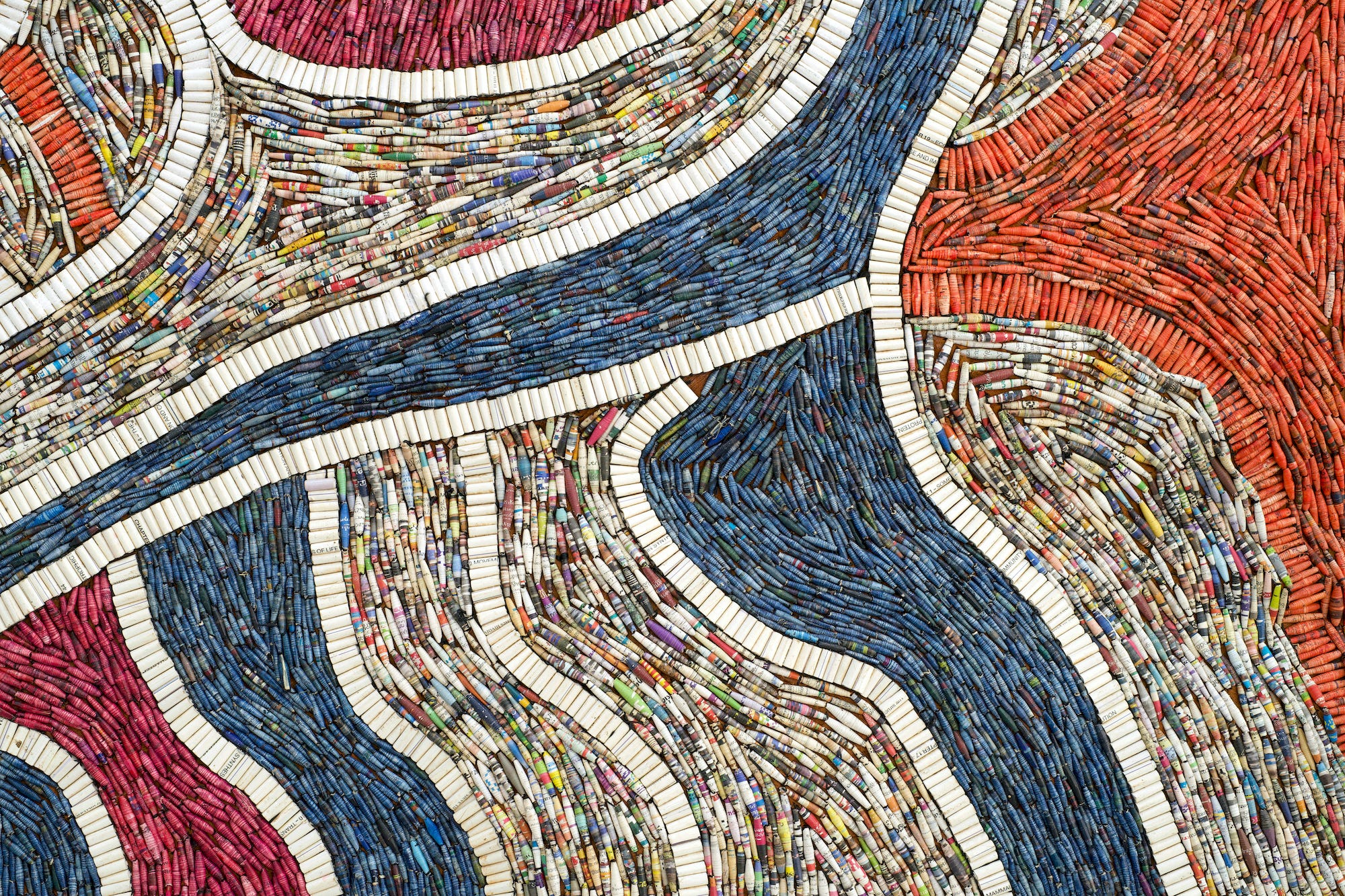
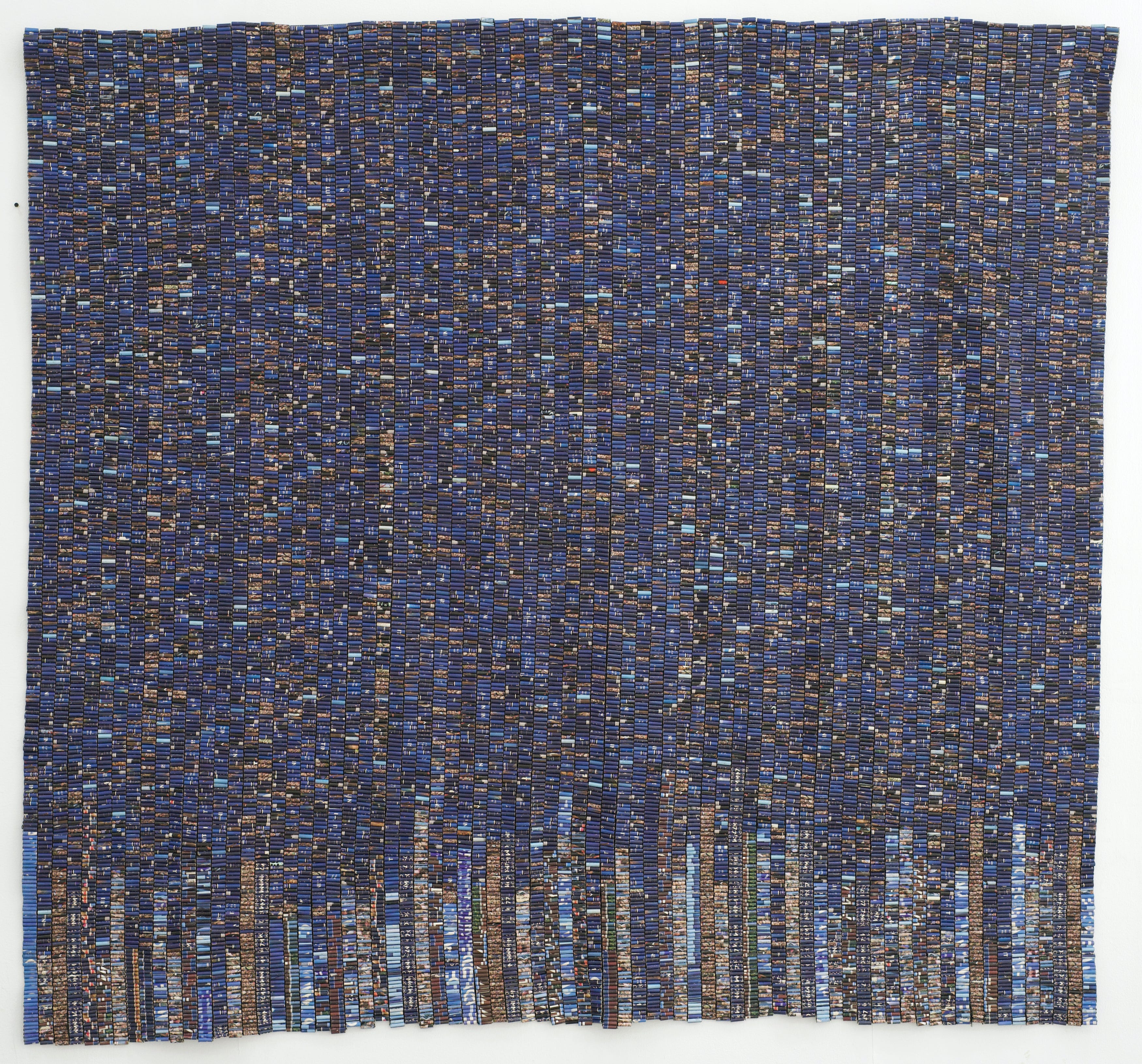
Paper has a grammage that is very important in making beads. Newspapers can make a circular kind of bead: you make a tube, and then you wrap it around into a little wheel. It’s very delicate, and you treat it differently. But a magazine like House & Garden, for example, or the other colourful magazines. That paper is absolutely right for beads, because it is glossy and it has good colour. It’s quality paper, and so that one works very well. Then you have novels. People throw away novels or give them away. Those, you pluck out the paper and you roll them into little tubes, and then you do them just like the newspaper, because the paper is very thin. It changes colour after a while, so it’s a different type of paper.
Then you get the advertising and the politicians’ paper that they print: posters. Like the Obama beads, for example, that I make. I had a whole half a tonne of publicity materials from his last campaign. I knew somebody in the Chicago campaign office who wrote to me and said, “Would you be interested in this paper? Because we’re going to shred and burn everything,” or whatever they do. And I said, “Yeah.” So I arranged shipping, and I had to pay freight and so forth.
That paper is heavy. It’s a very good colour. It’s beautiful, and it has information that is important to us all. And when these beads are rolled, because they contain information, they become little talismans. They contain information that is important. It reminds me of the silver talismans that we used to wear when we were kids, or leather talismans with a little message in them. And so the beads are valuable in that sense.
They Too Are the Earth is the name of your latest exhibition, a title borrowed from Niyi Osundare’s poem. What are you looking at in your latest work?
I’m looking at how we treat materials, our environment, and how we respond to trees and grasses. The materials we have, the things that are around us, are part of the very earth we live on. We need to conserve, and actually honour and value these things: raw materials, paper and so forth.
Looking back at your very first exhibition, and now, after a long and very successful career, what would you say has been the biggest shift for you, whether within your art or within you as a person? Who are you now?
Well, I’m someone who would really love to uplift the people’s livelihood, those that walk with me, just like I did mine. And so I feel that my next thing to do would be to have a good studio and actually have my regular team that works in the studio. Because I have groups in the villages that roll beads for me and do this and that, and then we bring the beads into town, where I live now, to treat them. And then I have a team of experts who stitch and follow my sketches, and we are working back and forth together. I sketch this, and I add this, and I add this. I don’t want to overwhelm them, so I do things in bits and pieces while I’m supervising.
These are the people that I feel are so aware of what I’m doing, or what the materials are doing, and I would like to have them teach other people. So maybe in another year or two, I will be having a kind of institutional something that you may want to come and visit and be part of, and take part in creating something. That’s the direction.
What role do memory and spirituality and storytelling play in your work?
Very, very much a big part, because we grew up on stories, grew up on valuing objects as symbols of the spiritual. An object like a hoe, for example: a simple hoe that digs changes lives. You use it to grow plants, and it becomes so valuable as food.
When we were young, living in the villages, in the evening time, we would have finished supper, and we would sit by the fire in the house, and we would be talking, being told stories before we went to bed. And some of these stories were so interesting, we refused to go to bed. We wanted more. And then, of course, the parents would be tired, but as children we would stick around and refuse to go to bed. And then somebody would shout from some room somewhere and say that the fireplace spirit is going to come out and ask why you don’t go to bed. And, of course, there’s a stampede. So there were all sorts of things like that, that you see in everyday life.
After decades in East Africa, your work is now in major US and European museums, and at Venice. Were there ever any periods where you felt overlooked, and if so, what kept you going as an artist? Did recognition come easily, or has it been something you’ve built towards?
Recognition was not easy at all. However, my striving to create something that would engage a person’s eye and attention was the most important, whether here at home or abroad. I’ve gone through a lot to get to where I am. However, I feel that it’s all part of a journey, because our journeys are not easy. We are displaced sometimes; we have to move from here to there. We live in communities that have demands of you, and you have demands of them, and so sometimes you give and take. But as an artist, you are committed to your quest.
So I feel that the time is coming when, generally, people are going to be looking at what they call ordinary materials, or ordinary people, like we were in villages, and they must find us extraordinary. There’s got to be things coming out of us. It has to be extraordinary, because we refuse to give up. So I feel happy, and I want that to be part of my legacy, with the other artists and the young people.
What are you still curious about?
Oh, I’m still curious about creation. I’m very, very much curious about the way plants and leaves and nature appear to us, because I think the older one gets, the more interested in answers: to the symbolic, and to the very nature, the texture and the colour and the delicacy of things, and the harshness of other things as well. But in the observation, you tend to go back to play. I feel that we should be allowed to play more when we grow older. So I enjoy looking around, going to the countryside, and coming back refreshed and then inspired. Inspiration is my biggest search.
Sanaa Gateja’s latest exhibition runs at Afriart Gallery in Kampala until 21 November. More details here.
You can follow him here.
Thanks for reading and sharing. A special thanks to all of you who have recommended me to your readers. It is so appreciated.
A special thanks to Lara B at Afriart Gallery for making this interview possible.
Back in a fortnight.